

Circular Truss for Event Lighting: The Professional Guide to Aerial and Ground Structures
A standard square gantry defines a space, but a circular truss for event lighting creates a destination. In a high-pressure exhibition environment, the difference between a functional stand and a visually striking brand experience often comes down to the geometry of your overhead structure. You likely already understand that a 360-degree lighting focal point draws the eye from across the hall, yet the logistical reality of transporting curved sections and calculating aerial loading capacities can feel like a significant hurdle.
We’ve designed this professional guide to help you master the integration of circular systems without the stress. You'll learn how to select the right diameter for your rig, ensuring total compatibility with standard exhibition stands while maintaining a lightweight, high-strength profile. We will examine the practical benefits of 35mm aluminium tubing and rapid spigot and pin connections that slash assembly times. From understanding the latest IEC 63494-1:2026 safety standards to aligning aerial structures with your brand's physical footprint, this overview provides the technical clarity needed to execute complex rigging with total confidence.
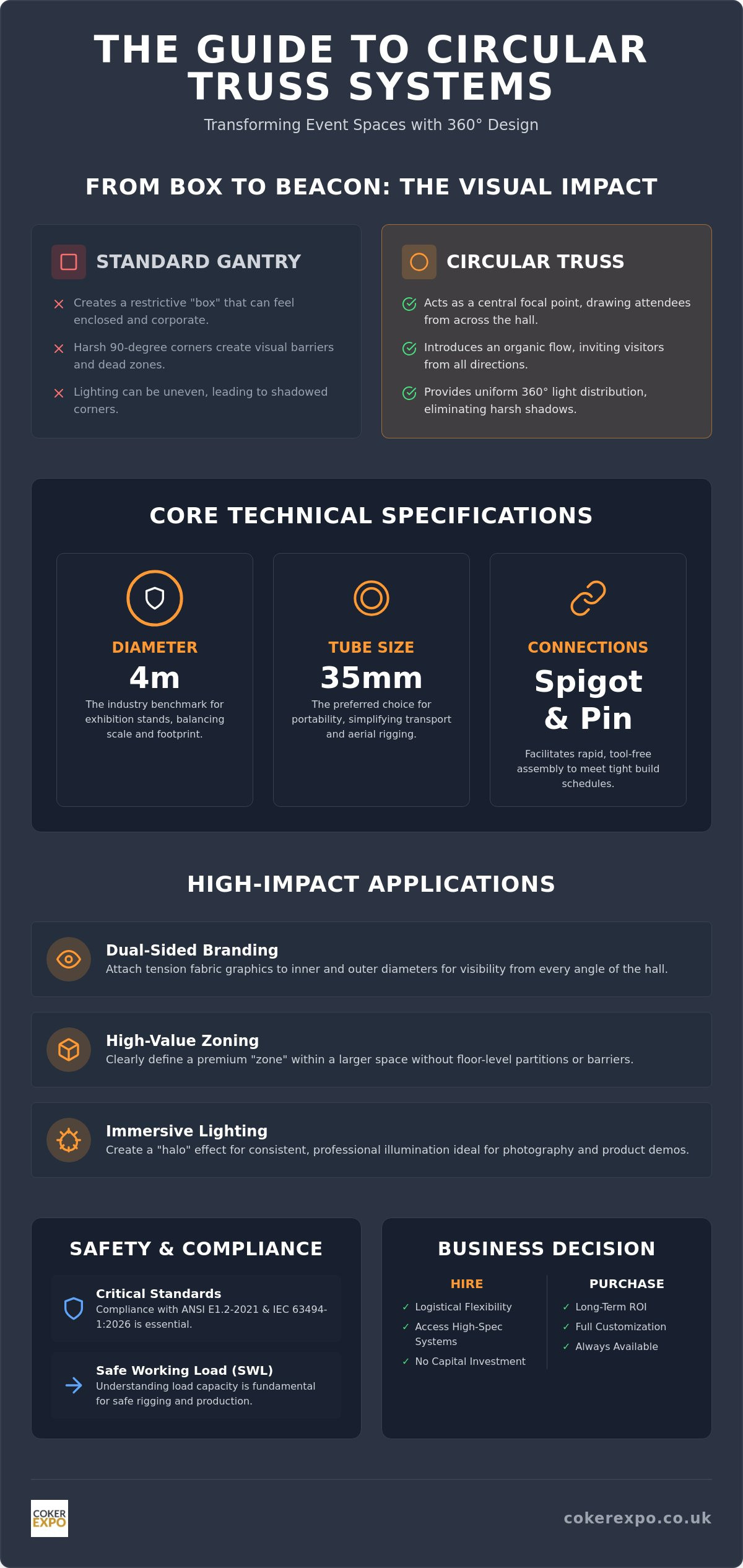
Discover how to transform your exhibition presence by moving beyond linear designs to create an organic, 360-degree focal point. This guide explains why a circular truss for event lighting is the preferred choice for defining high-impact brand zones and eliminating the harsh corners of traditional gantry systems. It's a strategic move that turns a functional lighting rig into a central architectural feature of your stand.
Gain technical insights into industry-standard specifications, including why 4m diameters and 35mm aluminium tubing offer the ideal balance of high-strength performance and portability. We detail the practical benefits of spigot and pin connections, which facilitate rapid assembly and help operators meet tight build windows at demanding national venues. These features ensure your infrastructure is as resilient as it's easy to transport and construct.
Understand the critical safety requirements for aerial rigging and how to integrate these structures with existing exhibition systems or ground-support plinths. Whether you're weighing the long-term ROI of a permanent purchase or the logistical flexibility of lighting truss hire, you'll find the practical data needed to make an informed business decision. This guide simplifies complex rigging logistics so you can focus on achieving a significant visual impact in any professional environment.
Understanding the Impact of Circular Truss in Event Design
A circular truss for event lighting is a modular aluminium assembly designed to provide a continuous, curved mounting point for luminaires and branding. While linear gantries are the standard for perimeter support, circular systems utilize the fundamental structural principles of a truss to create a self-supporting loop that eliminates the visual and physical barriers of 90-degree corners. This shift in geometry changes how attendees interact with a space. In a busy exhibition hall, a circle acts as a "centre of gravity," pulling the gaze toward a central focal point like a product reveal or a keynote stage.
Linear structures often create a "box" that can feel restrictive or overly corporate. In contrast, circular geometry introduces an organic flow that invites visitors into the stand from any direction. It's a strategic design choice that prioritizes accessibility and 360-degree visibility, ensuring your brand isn't hidden behind structural uprights or shadowed corners.
Creating a 360-Degree Brand Experience
Circular structures offer a level of uniform light distribution that linear frames can't match. By positioning fixtures along a curve, you eliminate the "dead zones" and harsh shadows often found in the corners of square stands. This setup is particularly effective for several applications:
- Dual-Sided Branding: Attaching tension fabric graphics to both the inner and outer diameters creates visibility from every angle of the hall.
- Zoning: A 4m diameter circle suspended overhead clearly defines a high-value "zone" within a larger, open-plan space without requiring floor-level partitions.
- Immersive Lighting: Creating a "halo" effect that wraps around a display provides consistent illumination for photography and product demonstrations.
Aesthetic vs. Functional Requirements
Choosing between a full 360-degree circle and a semi-circular arc depends on your floor plan and rigging limitations. While a full circle provides the most dramatic visual impact, a semi-circle can serve as an effective backdrop support for a shell scheme or a curved LED wall. A circular truss for event lighting acts as a structural anchor for high-impact lighting, ensuring that heavy moving heads or branded banners remain secure while maintaining a professional, high-end aesthetic. Whether used as an aerial gantry or a ground-supported "halo" on plinths, the goal is to balance the visual impact with the practicalities of transport and assembly.
Technical Specifications: Diameters, Tube Sizes, and Loading
Selecting the right circular truss for event lighting requires a precise balance between visual scale and logistical limits. The 4m diameter circle has emerged as the industry benchmark for exhibition stands. It's large enough to encompass a central meeting area or product display while leaving sufficient clearance within a standard 6m x 6m footprint. Choosing the correct tube diameter is equally critical for transport. While 50mm tubing is common in heavy-duty concert touring, the 35mm aluminium tube is the preferred choice for portable exhibition use. It's significantly lighter, which simplifies aerial rigging in venues with restricted ceiling capacities and reduces the physical strain on your build team.
Durability is a non-negotiable factor for hardware that undergoes repeated assembly and transport cycles. High-grade aluminium alloys provide the resilience needed to prevent warping over time. To ensure a professional finish, the segments must feature precision-machined joints that remain flush under load. If you're looking for a versatile solution for your next project, exploring professional lighting truss hire can provide access to these high-spec systems without the upfront capital investment.
Calculating Loading Capacity (SWL)
Understanding the Safe Working Load (SWL) is fundamental to safe event production. Compliance with ANSI E1.2-2021 safety standards ensures that your structure can handle the intended equipment. Weight distribution on a curve differs from straight spans because the load is spread across a circular arc, which can affect the stability of the rigging points. You must distinguish between:
- Point Loads: The weight of a single fixture, such as a heavy moving head, concentrated on one spot.
- Distributed Loads: Evenly spaced items, like LED par cans or lightweight branded banners, spread around the circumference.
Modular Segment Breakdown
Logistics often dictate the design of a circular truss for event lighting. A standard 4m circle is typically manufactured in four or eight modular segments. This breakdown allows the curved sections to fit into standard flight cases or small delivery vehicles, solving the common headache of transporting oversized hardware. The spigot and pin system is vital for reducing exhibition build times because it allows for tool-free, secure connections that can be completed in minutes. This precision ensures that once the pins are driven home, the circle is perfectly aligned and ready for suspension or ground-support use.
Safe Rigging and Integration with Exhibition Systems
Executing a safe installation requires more than just high-quality hardware. It demands a strict adherence to safety standards. In the UK, aerial rigging must comply with LOLER (Lifting Operations and Lifting Equipment Regulations) and specific venue requirements for suspended structures. When ceiling rigging isn't an option, ground-support systems provide a reliable alternative. You can mount a circular truss for event lighting on heavy-duty base plates or custom plinths to create a freestanding "halo" that maintains the visual impact without the need for overhead points. For detailed loading tables and advanced rigging configurations, Prolyte's Technical Blackbook serves as a vital resource for ensuring your setup is engineered for total stability.
A circular truss for event lighting shouldn't exist in isolation. It must be integrated into your overall exhibition stand design to ensure a cohesive brand aesthetic. Professional cable management is essential on curved structures. Unlike linear spans, cables on a circle are more visible from multiple angles. We recommend securing power and DMX lines along the inner chord using low-profile ties to maintain a clean, architectural finish. If you're planning a complex multi-system build, our team provides full event management and planning support to handle the technical logistics from start to finish.
Combining Truss with Tension Fabric (TFS)
You can transform a structural circle into a high-impact branding tool by using it as a frame for Tension Fabric Systems (TFS). This allows you to create high-level "halo" graphics that wrap around your entire stand. To achieve a drum-tight finish, the fabric must be precisely tensioned against the curved aluminium profile. This prevents sagging and ensures your branding remains crisp under bright exhibition lights. For more information on combining different framework styles, refer to our comprehensive truss truss guide.
Lighting Integration: Beyond the Par Can
The curved radius of a circular gantry allows for creative fixture placement that linear systems can't accommodate. You can mount moving heads, LED bars, and spotlights at varying intervals to create a dynamic, 360-degree light show. Many exhibitors now use dynamic lightboxes on the floor to complement the overhead rig, creating a multi-layered lighting environment. Another effective technique involves placing internal LED strips within the truss webbing. This creates a "glow" effect that highlights the structure itself, turning the hardware into a decorative element of the stand.
Planning Your Event Logistics: Hire vs. Purchase
Deciding whether to invest in a circular truss for event lighting depends on your annual exhibition frequency. For businesses attending one or two shows a year, hiring is the most logical financial choice. It allows you to test different stand layouts without committing capital to hardware that sits in storage for ten months. If your calendar includes five or more national events, purchasing provides a clear long-term ROI. Ownership gives you total control over your inventory, though it introduces the responsibility of logistics and maintenance.
Transporting curved sections presents a unique challenge compared to straight spans. Even when broken down into quadrants, curved segments take up significant volume in a transit van. You can't stack them as efficiently as linear beams. This "dead space" requires careful vehicle planning to avoid multiple trips. Additionally, lead times for circular components are often longer than straight stock. Most circles are manufactured to order or held in smaller quantities, so we recommend planning at least six weeks in advance for bespoke purchases to avoid build-window stress.
National Supply and Event Management
Managing a complex 360-degree rig requires technical expertise that goes beyond basic assembly. A professional partner provides the structural drawings and health and safety documentation required by UK venues. CokerExpo offers national UK supply and comprehensive event management support to bridge the gap between design and delivery. We simplify the process from the initial technical drawing to on-site assembly, ensuring your circular truss for event lighting is delivered and rigged according to your specific schedule.
Maintenance and Longevity
Maintaining the integrity of your aluminium structure is vital for both safety and aesthetics. You should inspect every segment for dents, stress fractures, or worn connection points after every event. Regular cleaning with specialized aluminium polish keeps the hardware looking professional and prevents the oxidation that can dull the finish over time. Professional lighting truss hire removes the burden of storage, ongoing safety inspections, and hardware maintenance, allowing your team to focus entirely on lead generation and brand engagement.
Executing Your Circular Truss Strategy
Implementing a circular truss for event lighting is a strategic decision that moves beyond simple equipment mounting to architectural brand definition. By utilizing lightweight, high-strength aluminium systems, you simplify the rigging process and ensure your team can meet demanding exhibition build schedules. Whether you opt for a 4m aerial gantry or a ground-supported halo, the focus must remain on safety compliance and precision engineering to achieve a professional result.
As specialists in exhibition hardware since 1999, we provide expert advice on UK-wide event rigging to help you navigate complex logistics with total confidence. Our hardware is designed for resilience and rapid assembly, ensuring a significant visual impact in any professional environment. View our range of Circular Lighting Truss and Gantries to find the essential infrastructure for your next project. With the right hardware and a clear logistical plan, you can create a high-impact focal point that defines your space and engages every visitor.
Frequently Asked Questions
How many people are needed to assemble a 4m circular truss?
Two people can typically assemble a 4m circular truss for event lighting in a matter of minutes. The lightweight 35mm aluminium construction makes individual quadrants easy to lift, while the spigot and pin connection system allows for tool-free assembly without the need for a large crew.
Can I hang a circular truss from any exhibition hall ceiling?
Suspension depends entirely on the venue's specific rigging point layout and the Safe Working Load (SWL) of the ceiling structure. You must consult the venue's technical floor plan or work with an event management partner to confirm that the overhead points can support the weight of the truss and all attached lighting fixtures.
What is the difference between 35mm and 50mm circular truss for events?
The primary difference lies in the load-bearing capacity and portability. A 35mm diameter tube is designed for lightweight exhibition use, offering easier transport and rigging for standard lighting rigs. The 50mm version is a heavy-duty touring standard used for large-scale concerts where massive weight capacities are required for heavy moving heads and LED screens.
Can circular truss be used outdoors for festivals or brand activations?
Circular truss can be used outdoors, provided you account for wind loading and ground stability. Aluminium is naturally resistant to corrosion, making it suitable for varying weather conditions, but you must use appropriate ballasting or ground-support legs to ensure the structure remains secure in exposed environments.
How do I attach fabric graphics to a circular lighting gantry?
The most professional method is using a Tension Fabric System (TFS) designed to fit the specific curve of the aluminium profile. This creates a drum-tight "halo" effect. For simpler applications, you can use high-quality printed banners secured with low-profile cable ties or bungees along the inner or outer chords of the structure.
Is a circular truss more expensive to hire than a square one?
Hiring a circular truss for event lighting usually involves a higher cost than a standard square gantry. This price difference reflects the specialized manufacturing process required to roll aluminium into precise curves and the increased transport volume occupied by curved quadrants compared to stackable straight sections.
Laisser un commentaire