

UV Printing to PVC boards for exhibition graphics
How many times have you unboxed your exhibition panels only to find a deep scratch running right through your company's logo? It's a frustrating reality for event managers who must maintain a flawless professional presence while navigating tight logistical windows. You need graphics that can withstand the friction of transport and the harsh, glaring lights of a trade show floor without losing their visual impact. Choosing UV Printing PVC board exhibition graphics ensures your brand remains sharp and legible, providing a level of resilience that traditional vinyl simply cannot match.
This article explains how UV-cured PVC graphics provide the durability and clarity necessary for high-traffic trade shows and professional events. We'll look at the technical advantages of UV-LED curing technology, which now accounts for over 78% of the printer market, and how it creates a scratch-resistant finish that eliminates glare. You'll also learn about the practical benefits of rigid panels, from their ease of installation in shell scheme frames to meeting the latest 2026 fire safety classifications. This is your guide to making a sound business investment in reusable, high-performance display infrastructure.
Key Takeaways
- Understand the technical advantages of UV-curable inks on Foamex substrates to ensure a long-lasting, professional finish for your event infrastructure.
- Discover how UV Printing PVC board exhibition graphics provide essential scratch resistance and anti-glare properties for high-traffic trade show environments.
- Learn the strategic application of rigid panels to upgrade standard shell schemes and create high-impact, custom-branded display plinths.
- Master the procurement process by identifying the correct board thickness and artwork specifications required for seamless, tool-free installation.
The Science of UV Curing on Rigid PVC Substrates
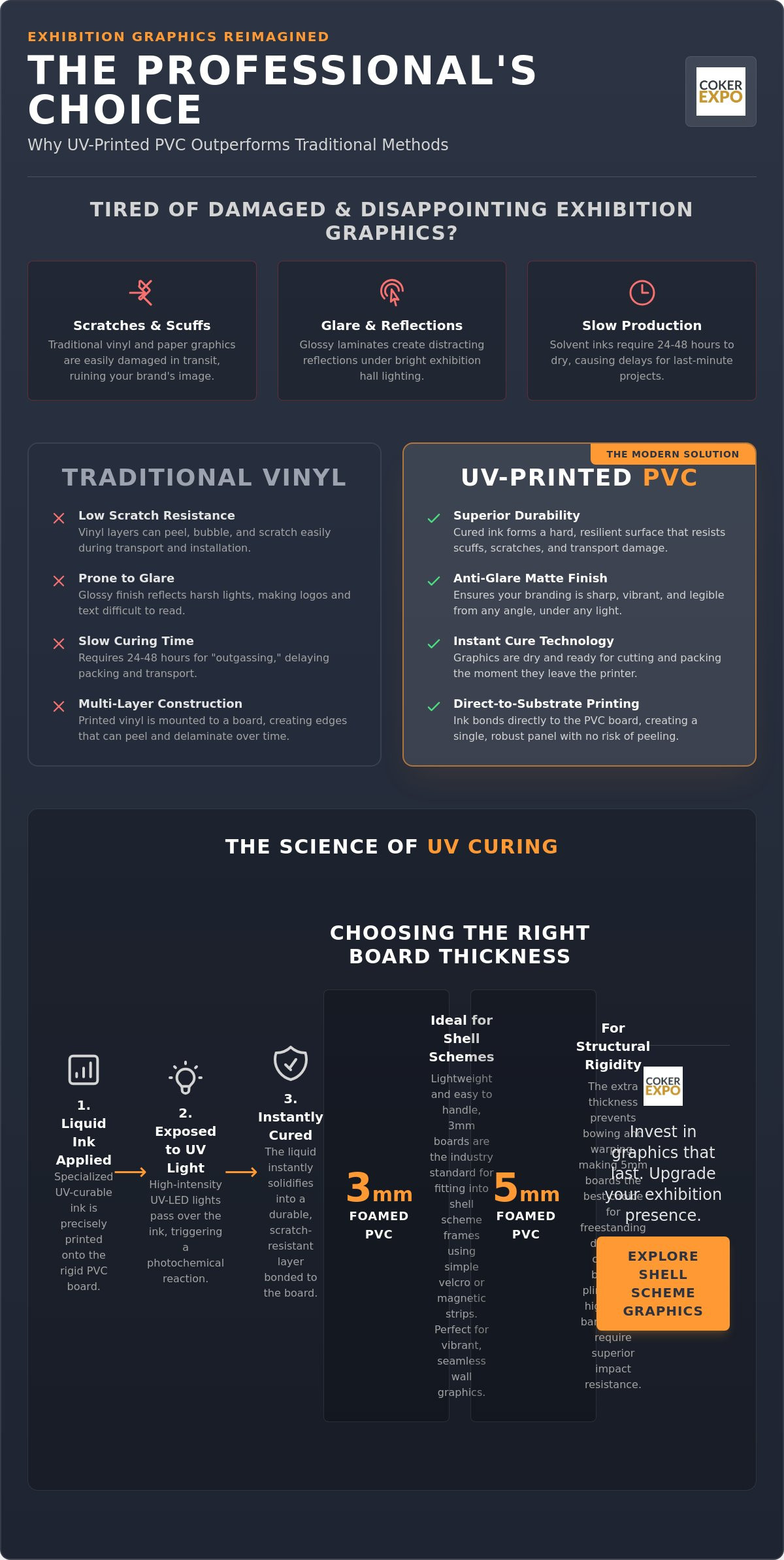
UV printing isn't just an alternative to traditional methods; it's a fundamental shift in how we approach large format production. Unlike solvent-based printing that relies on evaporation to dry, UV printing uses high-intensity ultraviolet lights to trigger a photochemical reaction. This process, known as The Science of UV Curing, instantly transforms liquid ink into a solid, durable film. For decision-makers, this means your UV Printing PVC board exhibition graphics are ready for the floor the moment they leave the printer bed. There's no risk of the ink smudging or the surface remaining tacky during a rushed installation.
Foamed PVC, often referred to by the brand name Foamex, has become the industry standard for Shell Scheme Graphic Panels for several practical reasons. It provides a smooth, flat surface that ensures your brand colours remain consistent across multiple panels. Historically, graphics were printed onto vinyl and then mounted onto boards. This method often led to bubbling or peeling at the edges over time. Direct UV printing eliminates these layers entirely. The ink bonds directly to the substrate, creating a resilient finish that doesn't require lamination to survive a standard event cycle. Additionally, UV inks are typically VOC-free. This makes them a safer, more sustainable choice for indoor environments where hundreds of exhibitors are gathered in a single hall.
Foamed PVC vs. Hard PVC: Which is Best for Exhibitions?
Choosing the right substrate depends on where your graphics will live. Foamed PVC is the go-to for indoor displays because it's incredibly lightweight. It's easy for your team to carry and mount using simple Velcro or magnetic strips. We typically recommend 3mm boards for standard shell scheme inserts to keep weight manageable. However, if you're investing in External Notice Boards or high-traffic barriers, hard PVC is the better choice. It's denser and offers superior impact resistance. For freestanding displays, moving up to a 5mm thickness provides the necessary structural rigidity to prevent bowing or warping under heavy lighting.
The Instant Curing Advantage
Speed is a critical factor in the exhibition industry. Traditional solvent inks require "outgassing," a period where gases escape the ink as it dries. This can take 24 to 48 hours before you can safely pack the graphics. Because UV Printing PVC board exhibition graphics cure instantly, we can move straight to finishing and cutting. The bond created during curing is exceptionally strong, meaning the ink won't crack when the boards are trimmed to size. You get a cleaner edge and a faster turnaround, which is essential when deadlines are tight and the show opening is non-negotiable.
Durability and Impact: Why UV Printing is the Professional Choice
The logistical journey from the warehouse to the trade show floor is the ultimate test for any display material. Traditional vinyl-mounted graphics often struggle here, as the layers can delaminate or catch on the edges of other equipment during transit. Choosing UV Printing PVC board exhibition graphics eliminates these vulnerabilities. The ink becomes part of the board itself, creating a surface that's significantly more resilient to the scuffs and scrapes that occur during loading and unloading. This "van-to-venue" durability ensures your branding arrives in the same condition it left the production facility.
Industry experts recognize this technology as the professional choice for signage because it balances aesthetic quality with extreme physical toughness. Unlike paper-based graphics that can absorb moisture or yellow over time, UV-curable inks remain stable under the intense indoor UV exposure common in large arenas. This stability makes it a sound investment for companies looking to reuse their panels across multiple events. It also introduces a "touchability" factor; attendees can interact with your stand or lean against plinths without leaving the visible fingerprints or smudges that plague gloss-laminated surfaces.
Scratch Resistance & Transport Logistics
Laminated paper graphics are prone to "dog-eared" corners and surface creasing if they aren't handled with surgical precision. Rigid PVC boards don't have these issues. Because the ink is hardened via polymerization, it doesn't require a separate protective film that might peel or bubble. When packing for national transport, we recommend using interleaved foam sheets between panels to prevent vibration-based burnishing. This simple step, combined with the inherent rigidity of the board, keeps your Shell Scheme Graphic Panels looking pristine year after year.
Colour Fidelity & Anti-Glare Performance
Exhibition halls are notorious for harsh, multi-directional LED lighting that creates distracting hotspots on glossy surfaces. UV inks naturally dry to a sophisticated matte finish, which is vital for clear event photography and attendee readability from all angles. Because the ink sits on top of the PVC rather than soaking in, the dots remain sharp and the colours stay vibrant. High UV ink density ensures that even fine text remains perfectly legible against dark backgrounds without the "bleeding" effect often seen in solvent printing.
Integrating PVC Graphics into Your Exhibition Stand Strategy
Exhibition stands often start as a blank canvas of silver poles and grey walls. Integrating UV Printing PVC board exhibition graphics allows you to reclaim that space and turn a generic shell scheme into a premium branded environment. While rollable graphics are common, rigid panels offer a superior finish that stays perfectly flat, even in humid hall conditions. This stability is essential for maintaining a high-end aesthetic throughout a multi-day event. By moving away from flexible materials, you eliminate the risk of unsightly waves or curls that can undermine your professional image.
Seamless Shell Scheme Solutions
When planning your stand, you must choose between "infill" panels and "over-the-pole" graphics. Infill panels fit exactly between the upright aluminium extrusions, while over-the-pole graphics cover the structure entirely for a seamless wall effect. Rigid PVC boards are the ideal choice for both methods because they won't warp or catch on the hardware. For a deeper look at maximizing your stand's potential, consult our Exhibition Stand Design guide. Using these panels as part of your shell scheme graphic panels strategy ensures a professional, architectural feel that rollable alternatives cannot replicate.
Beyond the Wall: Plinths, Counters, and Cut-outs
The versatility of UV printing extends far beyond wall panels. You can use the same technology to produce high-impact branding for Promotional Counters and Custom Display Plinths. This ensures total colour consistency across your entire stand, whether an attendee is looking at a back wall or a product display. By using CNC milling, we can cut rigid PVC into bespoke shapes, such as oversized company logos or product silhouettes. This breaks the "rectangular" monotony of the exhibition hall and creates a more dynamic, three-dimensional space. If you also use TFS Tension Fabric systems or lightboxes, matching the UV print density on your rigid panels is vital for a cohesive brand experience.
To start building your custom stand infrastructure, view our full range of Exhibition Counters and Plinths to find the right fit for your next event.
Procuring and Preparing High-Impact Rigid Graphics
The success of your display depends on the quality of the source files and the technical specifications of the substrate. For UV Printing PVC board exhibition graphics, your artwork must be high-resolution to avoid pixelation on a large scale. We require a minimum of 150dpi at full size. While digital screens operate in RGB, professional print production uses CMYK colour profiles to ensure your brand colours are reproduced with absolute accuracy. This technical preparation prevents costly reprints and ensures your stand looks exactly as the design team intended.
Beyond the visuals, you must consider the logistical requirements of the venue. Most UK exhibition centres mandate that all display materials meet specific fire safety standards, typically Class 1 or B1 ratings. We verify these certifications during production to ensure your stand remains compliant with health and safety inspections. Lead times are also a critical factor; we recommend finalizing your order at least 10 working days before your event to allow for precision cutting and national delivery. This window provides a necessary buffer for the high-pressure, deadline-driven nature of the event industry.
Artwork Specifications for UV Printing
Vector files are the superior choice for large logos and custom-cut shapes because they can be scaled infinitely without losing sharpness. If your design includes photography, ensure the files are embedded and meet the 150dpi threshold. To achieve a professional edge-to-edge finish, your artwork must include a 3mm to 5mm "bleed" to allow for minor variances during the CNC milling process. This small technical detail prevents unsightly white borders from appearing on the finished panels.
Fixing and Installation Tips
Choosing the right board thickness is a functional decision based on your fixing method. 3mm Foamex is lightweight and ideal for industrial Velcro, making it a popular choice for shell scheme infills. If you prefer a magnetic tape system for a more seamless look, 5mm boards provide the extra rigidity needed to hold the weight of the magnets without bowing. To protect your investment between shows, clean the panels with a soft, damp cloth and store them flat in a temperature-controlled environment. This prevents warping and ensures the UV Printing PVC board exhibition graphics remain a reusable asset for multiple years.
Ready to upgrade your display infrastructure? Enquire about our large format printing services today to discuss your bespoke requirements with our production team.
Maximise Your Event Impact with High-Performance Graphics
Investing in high-quality display infrastructure is a strategic decision that pays dividends across multiple event cycles. By choosing UV Printing PVC board exhibition graphics, you ensure your brand remains vibrant and professional despite the rigours of national transport and high-traffic environments. These rigid panels don't just provide superior visual clarity; they offer the logistical reliability that busy event managers require to alleviate on-site stress.
Our facility provides UK-based production and national delivery to meet even the tightest exhibition deadlines. We offer expert advice on everything from standard shell scheme infills to complex, bespoke custom stand configurations. This ensures your graphics meet all necessary fire safety ratings and resolution standards before they reach the venue floor. High-performance UV printing is the essential foundation of a durable, reusable exhibition kit that represents a sound business investment for years to come.
Explore Professional Exhibition Graphics and Rigid Panels to start planning your next high-impact display. We're ready to help you build a professional presence that stands out from the competition.
Frequently Asked Questions
What is the difference between Foamex and PVC board?
Foamex is a specific brand name for foamed PVC board. It's the industry standard for indoor displays because it features a compressed cellular core that makes it significantly lighter than solid PVC. This lightweight property is essential for exhibition staff who need to transport and install panels quickly without specialized lifting equipment. While solid PVC is denser and better suited for permanent construction, Foamex provides the smooth, flat surface required for high-quality graphic reproduction.
How long do UV printed PVC graphics last?
UV Printing PVC board exhibition graphics typically last between five and ten years when used in indoor environments. The UV-curing process creates a chemical bond that is highly resistant to fading from indoor LED and halogen lighting. Because the ink is hardened instantly via polymerization, the graphics maintain their original colour vibrancy across multiple event cycles. This durability makes them a superior long-term investment compared to traditional paper-based or solvent-printed alternatives.
Can UV printed PVC boards be used outdoors?
Yes, UV printed PVC boards are suitable for short to medium-term outdoor applications. The UV-curable inks are inherently waterproof and weather-resistant, so they won't run or bleed if exposed to rain. For external use, we recommend using a 5mm thickness to provide better structural stability against wind loads. If the graphics are intended for permanent outdoor signage, additional protective coatings may be required to extend the life of the substrate itself.
Are PVC exhibition graphics fire-rated for UK venues?
Professional-grade PVC boards used for event graphics carry a Class 1 or B1 fire rating. This certification is a mandatory requirement for almost all major UK exhibition venues, including the NEC and ExCeL London. Using fire-rated materials ensures your stand complies with strict health and safety regulations. We provide the necessary documentation to prove compliance, which helps alleviate logistical stress during the venue's site inspection process.
How do I clean UV printed graphics without damaging the ink?
You should clean UV printed graphics using a soft, lint-free cloth and lukewarm water mixed with a mild detergent. It's important to avoid using harsh chemicals, alcohol-based cleaners, or abrasive scrubbers, as these can dull the matte finish of the ink. Gently wiping the panels after each show removes dust and fingerprints, preserving the professional appearance of your UV Printing PVC board exhibition graphics. Always ensure the panels are completely dry before packing them away for storage.
What is the maximum size for a single UV printed PVC panel?
The standard maximum size for a single rigid PVC sheet is 3050mm by 1500mm, which is approximately 10ft by 5ft. While we can print onto these large format boards, we often advise clients to split extremely large graphics into smaller sections. This makes the panels much easier to transport in standard vehicles and simplifies the installation process for your on-site team. Splitting the panels also reduces the risk of the boards snapping or warping during transit.
Leave a comment