

The Ultimate Buying Guide to Cord Carpet for UK Exhibitions
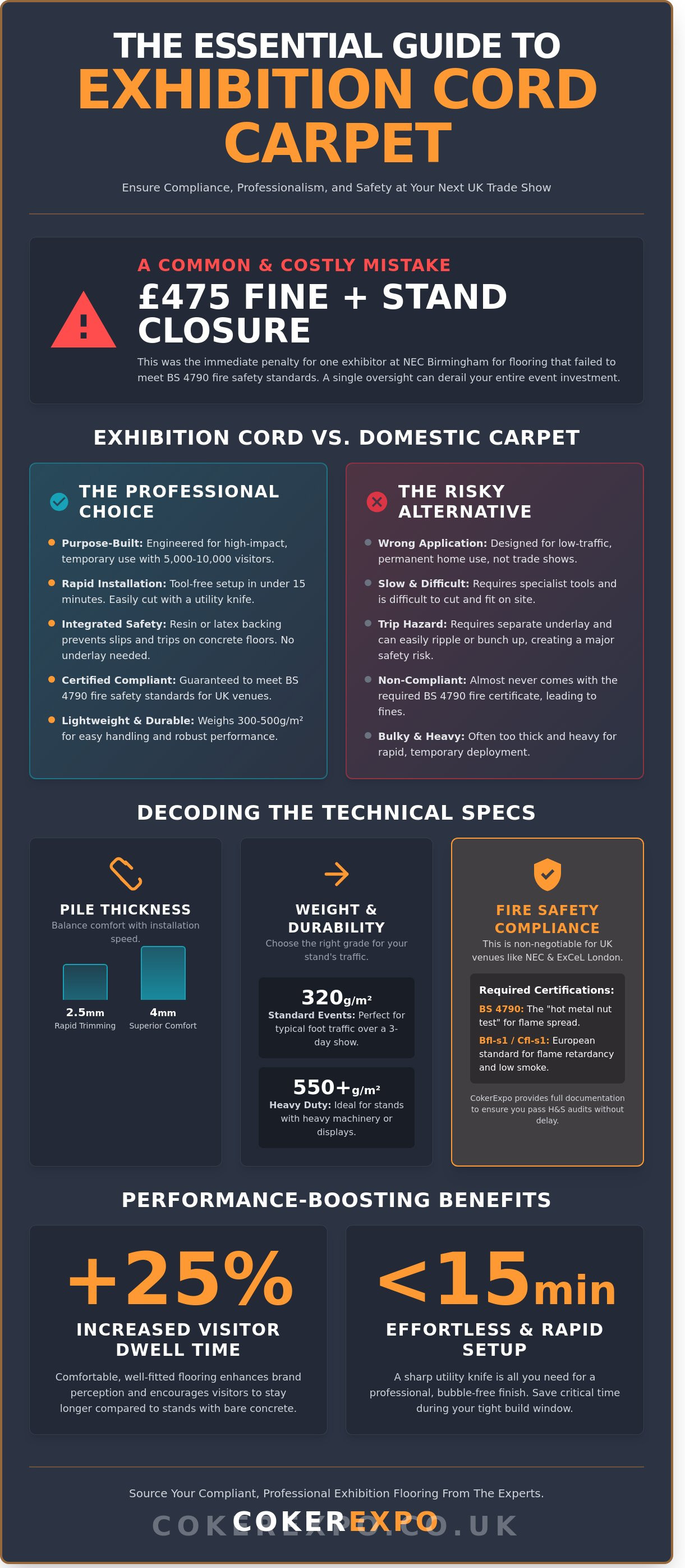
Last October at the NEC Birmingham, a marketing manager faced an immediate £475 surcharge and a potential stand closure because their flooring failed to meet BS 4790 fire safety standards. It's a high-stakes environment where a single technical oversight can derail months of planning and investment. You're likely balancing the need for a professional-looking stand with a tight budget, all while worrying about the logistics of a fast-paced build and strict venue regulations.
We agree that your floor shouldn't be a source of stress or a drain on your resources. Choosing the right cord carpet is the most effective way to secure a robust, impactful finish without the premium price tag of luxury alternatives. This guide will show you exactly how to select the correct specification for your trade show stand, ensuring you meet every health and safety rule while maintaining a polished brand image. We'll examine the technical differences between 2mm and 4mm piles, explain the importance of fire certification, and provide a step-by-step method for a tool-free installation that takes less than 15 minutes to complete.
Key Takeaways
- Understand why cord carpet is the industry standard for UK trade shows, offering the perfect balance of durability and cost-efficiency.
- Learn how to interpret technical spec sheets to ensure your choice meets essential venue safety and fire regulation requirements.
- Discover how to coordinate your flooring with shell scheme graphic panels to create a high-impact, professional brand environment.
- Gain practical insights into professional installation techniques and the essential toolkit required for a smooth, bubble-free finish.
- Explore how sourcing specialist exhibition flooring can streamline your event logistics and enhance the overall performance of your display.
What is Cord Carpet and Why is it Essential for UK Exhibitions?
In the high-pressure environment of UK trade shows, the floor is more than just a surface. It's a critical component of your stand's infrastructure. Cord carpet is a low-profile, needle-punch floor covering that has become the industry standard for events at major venues like the NEC Birmingham and ExCeL London. Its dominance stems from a precise balance of cost-efficiency and performance. While a premium plush carpet might look appealing in a showroom, it often fails to withstand the 5,000 to 10,000 visitors that can cross a standard 3x3m stand over a three-day period.
Flooring provides the psychological foundation for your brand. Industry data indicates that comfortable, well-fitted flooring can increase visitor dwell time by approximately 25% compared to stands using bare venue concrete. If a floor looks unfinished or feels unstable, visitors subconsciously perceive the brand as less professional. Domestic carpets are unsuitable for this task. They're designed for longevity over decades in a low-traffic home, not the rapid installation and high-impact footfall of a 48-hour trade exhibition.
The Anatomy of Professional Event Flooring
Professional event flooring is manufactured using a specialised needle-punch process. This involves thousands of barbed needles interlocking 100% polypropylene fibres to create a dense, flat surface. We use polypropylene because it's inherently stain-resistant and offers excellent colour fastness under harsh hall lighting. A low pile height, typically between 2mm and 3mm, ensures that heavy rolling equipment and flight cases move across the stand without snagging. This creates a robust finish that maintains its integrity even under the weight of heavy modular display systems.
Cord vs. Domestic Carpet: Key Differences
Trade-grade cord carpet differs significantly from residential flooring in its physical specifications. It's engineered for temporary, high-impact use rather than permanent comfort. Key differences include:
- Weight and Density: Exhibition cord usually weighs between 300g and 500g per square metre. This makes it light enough for rapid deployment by a small team without compromising on durability.
- Installation Efficiency: You don't need specialist power tools or heat-seaming equipment. A sharp utility knife is sufficient for precise cuts around gantry legs or floor power boxes.
- Integrated Backing: Unlike domestic rolls that require separate underlay, professional cord features an integrated resin or latex backing. This provides essential stability on polished concrete hall floors, preventing the dangerous ripples and trips that occur with unbacked domestic offcuts.
Choosing the right grade ensures your stand remains safe and visually impactful from the moment the doors open until the final breakdown. It's a practical investment that secures the professional image of your business during the most critical days of your marketing calendar.
Technical Specifications: Safety, Backing, and Durability
Selecting a floor covering for a high-traffic trade show requires more than a simple colour choice. You need to understand the technical data behind the product. A standard cord carpet for a three-day event typically features a pile weight of 320g/m². This provides enough durability to withstand thousands of footsteps without fraying or shedding fibres. If your stand includes heavy machinery or display plinths, look for a total weight exceeding 550g/m² to prevent permanent indentation.
Manufacturer spec sheets often highlight the trade-off between carpet thickness and installation speed. A 4mm carpet offers superior underfoot comfort on hard concrete halls, but it's more difficult to trim around complex stand geometries. A 2.5mm alternative allows for rapid trimming with a standard utility knife, which can save up to 20 minutes during a tight build window. Efficiency is vital when you're working against a fixed hall opening time.
UK Fire Safety Standards for Exhibition Carpets
Venues like the NEC Birmingham or ExCeL London won't let you open your stand without a valid fire certificate. All flooring must meet BS 4790 standards, which is the "hot metal nut test" used to measure flame spread. In European terms, you're looking for a Bfl-s1 or Cfl-s1 rating. These classifications ensure the material is flame retardant and produces minimal smoke if ignited. Coker Exhibition Systems Ltd (CokerExpo) provides full documentation for every roll, ensuring your site manager signs off your health and safety audit without any delays or fines.
Understanding Backing Options: Foam vs. Gel vs. Unbacked
The backing determines how the cord carpet interacts with the venue floor and impacts the safety of your staff. Choosing the wrong type often leads to "rucking," where the carpet bunches up and creates a trip hazard.
- Foam backing: This 2mm to 3mm layer provides essential cushioning. It's the standard choice for 85% of exhibitors because it masks minor imperfections in the subfloor and provides thermal insulation.
- Gel backing: Made from SBR rubber, this is waterproof and highly slip-resistant. It's the best choice for entrance zones or areas near water dispensers where moisture might reach the floor.
- Unbacked cord: This is a lightweight, 100% polypropylene option. It's the most cost-effective solution for short-term shell schemes and is much easier to recycle after a single use.
Selecting the correct specification ensures your stand remains professional and safe from the first keynote to the final breakdown. You can browse Coker Exhibition Systems Ltd (CokerExpo)'s technical flooring range to find the specific backing and fire rating required for your next venue.
Buying Guide: Choosing the Right Cord Carpet for Your Stand
Selecting floor coverings for a trade show requires a balance between aesthetic impact and logistical reality. Your choice should align with your specific exhibition objectives. If your goal is high-volume lead generation with heavy footfall, durability is your priority. For a high-end brand activation, the tactile feel of the flooring becomes more critical. You also need to decide between a single-use specification, typically a 100% polypropylene finish that is recycled after the event, or a multi-event carpet designed for repeated use across a full season of shows.
When calculating your order, always factor in a 10% waste margin for overlaps and perimeter trimming. For a standard 3m x 3m stand, ordering 10 square metres provides the necessary buffer to ensure a professional finish without visible gaps. This extra material is vital when navigating floor sockets or structural pillars within your allocated space. Approximately 15% of exhibitors underestimate their requirements, leading to frantic last-minute sourcing on build-up day.
The Cord vs. Rib vs. Velour Comparison
A standard cord carpet remains the industry benchmark for versatility and cost-efficiency. It provides a flat, needle-punch surface that withstands heavy trolley traffic and thousands of visitors without fraying. If you want a more architectural look, rib carpet features a raised linear texture that adds visual depth. For premium zones where you want to encourage visitors to linger, velour offers a plush, soft-pile finish. While velour is roughly 40% more expensive than cord, the perceived value it adds to a luxury product launch is a justifiable investment for many B2B brands.
Selecting Colours for Maximum Brand Impact
Your flooring should never compete with your primary messaging. We recommend using neutral charcoal or deep black tones to make your lightboxes stand out. Darker floors create a high-contrast base that forces the eye upward toward your illuminated graphics. If your stand features vibrant shell scheme graphic panels, a mid-grey carpet acts as a visual anchor that doesn't distract from your branding.
Practicality is just as important as design. Data from UK venue maintenance teams shows that mid-toned "salt and pepper" greys hide 30% more visible dust and footprints than solid black or white options. If you're exhibiting at a winter show where visitors bring in damp footwear, avoid light blues or creams. These colours show watermarks and grime within the first two hours of the hall opening. Stick to saturated primary colours only if they are a core part of your brand identity and you have a dedicated team to maintain the stand surface throughout the event.
Professional Installation: Achieving a Flawless Finish
A professional finish defines your brand's presence on the trade show floor. While Coker Expo focuses on tool-free modular systems, laying cord carpet requires a disciplined process to ensure it stays flat for the duration of a three-day event. Your kit bag must contain a heavy-duty retractable knife with fresh blades, a 1-metre steel straight edge, and 50mm high-tack exhibition tape. Accuracy during the build phase prevents the 15% of onsite accidents caused by lifting edges and trip hazards.
Preparation and Taping Techniques
Success begins with the subfloor. Venues like the NEC or Olympia often have dust-heavy concrete floors that compromise adhesive. Use a stiff brush or vacuum to clear the area before applying any tape. We recommend the "perimeter and cross" method for a ripple-free finish. Lay a continuous line of double-sided tape around the stand boundaries, then create a large 'X' from corner to corner. This technique secures the centre of the cord carpet, preventing it from bunching when heavy furniture is moved. Always use NEC-approved low-residue tape. This avoids the £50 per square metre cleaning fines that venue organisers levy for adhesive damage left on the hall floor.
Cutting and Seaming Like a Pro
Precision trimming is essential when fitting around structural elements. When you encounter uprights or folding display boards, make a relief cut from the carpet edge to the object. Trim the excess slowly, keeping the blade pressed against your straight edge for a clean line. For joins, overlap two rolls of carpet by 30mm, then cut through both layers simultaneously. This creates a butt-joint that is virtually invisible to the 2,000 plus visitors walking over it daily. Secure these seams with a dedicated line of high-tack tape underneath the join. This "Practical Specialist" approach ensures your flooring looks like a single, bespoke piece rather than a series of rolls.
Safety remains the final step of any installation. Check every perimeter edge for lift. If the carpet meets a public gangway, use a high-visibility floor transition strip or additional low-profile tape to seal the edge completely. This attention to detail reflects a professional, authoritative brand image that values visitor safety as much as aesthetic impact.
Ensure your stand is floor-to-ceiling professional by browsing our range of exhibition flooring solutions today.
Sourcing Quality Exhibition Flooring from CokerExpo
As a dedicated UK exhibition hardware specialist with over 30 years of industry experience, we recognise that flooring is the primary touchpoint for every visitor. Selecting our cord carpet means you're investing in a product engineered specifically for the rigours of the UK event circuit. We prioritise British manufacturing, ensuring every roll meets the BS 5287 fire safety standards required by major venues like the NEC and Olympia London. This commitment to local quality allows us to maintain a robust supply chain, offering next-day dispatch on stock items to mitigate the stress of last-minute event preparations.
Beyond Flooring: A Complete Stand Solution
Your floor shouldn't exist in a vacuum. It must work with your walls, lighting, and displays. Our flooring integrates perfectly with our wider range of modular systems, including our signature tool-free gantry and tension fabric displays. By coordinating your carpet with our event management and planning services, you ensure a unified aesthetic that reflects your brand's authority. Our Harrods Beauty case study shows how we translate high-end retail design into a functional exhibition format using premium materials. Our "Practical Specialist" approach removes the guesswork, providing a seamless build-up that lets your team focus on leads, not logistics. We focus on the user experience of the exhibitor, ensuring every component is easy to transport and quick to install.
Ordering Your Exhibition Cord Carpet
We make the procurement process as efficient as the installation itself. Whether you're managing a compact 3x3m shell scheme or a 200-square-metre custom island, we provide bespoke quotes that reflect the scale of your project. Our cord carpet is selected for its high-performance characteristics; it's impactful, versatile, and tough enough to handle heavy display cabinets without crushing. We understand the deadline-driven nature of this industry, which is why our delivery is as reliable as our hardware. Our team is ready to assist with technical specifications or volume discounts for multi-show contracts. We don't just sell equipment; we provide the infrastructure for your success on the trade show floor.
Ready to finalise your stand design? View our range of professional exhibition cord carpets today and secure the foundation your brand deserves.
Secure a Professional Foundation for Your Next Exhibition
Choosing the right cord carpet transforms a basic shell scheme into a high-impact, professional environment. Prioritising fire safety compliance, specifically meeting BS EN 13501-1 standards, is a non-negotiable requirement for major UK venues. Selecting a robust ribbed texture ensures your stand handles heavy footfall while maintaining a seamless aesthetic throughout the typical three-day event cycle.
CokerExpo provides the technical infrastructure and UK-based expert support required to navigate demanding event schedules. We provide 24-hour dispatch on stocked materials to ensure you meet every installation deadline without stress. Our flooring range guarantees full compliance with strict venue regulations, so you don't have to worry about health and safety paperwork. We're here to help you deliver a stand that looks exceptional and performs under pressure. Get your flooring right, and the rest of your build will follow suit.
Explore our professional cord carpet range for your next event and build your success on a reliable foundation.
Frequently Asked Questions
Is cord carpet fire rated for use in UK exhibition venues?
Yes, all cord carpet supplied for UK trade shows must meet specific fire safety standards, typically BS 4790 or Euroclass Bfl-s1. These certifications ensure the material is fire-retardant and safe for high-occupancy environments like the NEC or ExCeL London. We provide technical data sheets for our flooring to satisfy venue health and safety officers, ensuring your stand meets every 2024 regulation.
Can I reuse cord carpet for more than one trade show?
While cord carpet is primarily designed as a single-use solution for 3 to 5-day events, you can occasionally reuse it if it's lifted carefully. The main challenge is the high-tack tape used for installation, which often stretches the thin ribbing when removed. For a professional finish at your next show, we recommend fresh rolls to avoid visible creases or frayed edges that detract from your brand.
Do I need underlay when installing cord carpet on a concrete floor?
You don't need underlay when installing cord carpet on a concrete exhibition hall floor. This material is manufactured with a resin or latex backing that provides enough stability for short-term use. Skipping underlay saves you approximately £3.50 per square metre in material costs and reduces your installation time by 40% on a standard 6m x 3m stand.
How do I clean cord carpet if something is spilled during the event?
To clean a spill during an event, blot the area immediately with a clean, white cloth to absorb the liquid. Don't rub the surface; this can distort the needle-punch fibres and leave a permanent mark. For stubborn stains like coffee, a solution of 1 part mild detergent to 10 parts water works effectively. Most UK venues also offer 24-hour cleaning services for larger mishaps.
What is the standard width for exhibition cord carpet rolls?
The standard width for exhibition cord carpet rolls is 2 metres or 4 metres. A 50-metre roll of 2-metre wide carpet covers 100 square metres and is easy to transport in a standard transit van. Most UK organisers standardise stand depths at 3 or 4 metres, so these specific widths minimise waste and reduce the number of visible seams across your floor space.
Can I install cord carpet myself or do I need a professional fitter?
You can easily install cord carpet yourself on stands up to 36 square metres using basic tools like a utility knife and double-sided exhibition tape. For larger pavilions or complex layouts with floor ports, hiring a professional fitter ensures a seamless finish. A pro can typically lay 100 square metres in under 90 minutes, allowing your team to focus on stand graphics and product displays.
How do I remove the tape residue from the hall floor after the show?
Remove tape residue from the hall floor using a heavy-duty scraper and a citrus-based adhesive remover. Venue managers are strict about floor conditions; leaving residue can result in dilapidation charges starting at £50 per hour for cleaning. Always use NEC-approved double-sided tape to ensure the adhesive stays on the carpet backing rather than the concrete surface during breakdown.
What is the best colour of cord carpet for a high-traffic stand?
Charcoal, dark grey, and navy blue are the most effective colours for high-traffic stands because they hide footprints and scuff marks. Lighter shades like white or cream often look weathered after just 4 hours of visitor footfall. Data shows that darker flooring provides a neutral base that makes your branded graphics and 1000-nit LED screens pop, drawing more eyes to your displays.
Leave a comment