

The Professional Guide to Display Turntables for UK Exhibitions 2026
Research published on October 18, 2023, confirms that a moving display can increase sales by up to 30% compared to a static alternative. It's a powerful way to capture attention, yet many marketing managers hesitate because of the technical risks. You've likely worried about a motor failing mid-show, cables becoming a tangled mess, or the safety of a heavy ceiling-mounted rig. When you're investing in a display turntable for exhibitions UK events, you need equipment that works as hard as your sales team without requiring a complex toolkit to assemble.
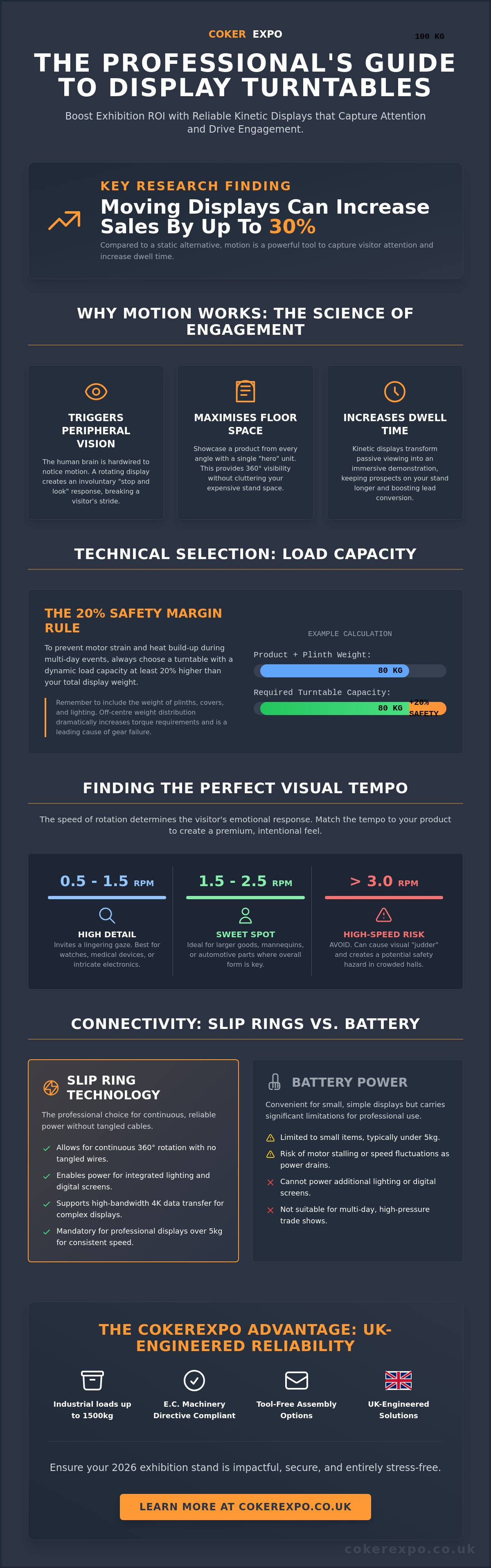
We understand that reliability is your primary concern. This guide provides a practical framework for selecting a rotating system that meets the professional 50kg load capacity threshold and complies with the E.C. Machinery Directive 2006/42/EC. You'll learn how to implement the 20% safety margin rule to protect your drive system and discover how modern slip rings allow for continuous power and 4K data transfer. We'll walk through everything from optimal rotation speeds to tool-free assembly, ensuring your 2026 exhibition stand remains impactful, secure, and entirely stress-free.
Key Takeaways
- Understand how movement triggers a visitor's peripheral vision to increase dwell time and reduce the need for multiple floor samples.
- Apply the 20% safety margin rule to your load capacity so you don't overwork the motor during a multi-day event.
- Identify why slip rings are the critical component for providing continuous power to rotating lighting or digital screens without cable tangles.
- Compare the visual impact of floor and ceiling mounts when choosing a display turntable for exhibitions UK to maximize stand visibility.
- Benefit from UK-engineered solutions that support industrial loads up to 1500kg with the reliability you'll need for high-pressure trade shows.
The Psychology of Movement: Why Use Display Turntables?
In a hall filled with hundreds of static shell schemes, the human brain is hardwired to seek out motion. This is a survival instinct rooted in our peripheral vision, which is significantly more sensitive to movement than to detail or colour. When a visitor walks past your stand, a rotating display triggers an involuntary "stop and look" response. By the time they've consciously identified the product, they've already broken their stride. This split-second engagement is the foundation of increasing booth dwell time.
Utilising a display turntable for exhibitions UK events also solves a practical spatial problem. Exhibition floor space is expensive. Instead of cluttering your stand with four or five samples to show a product from every angle, a single rotating "hero" unit provides total 360-degree visibility. This approach originated in the history of revolving stages, where movement was used to reveal new perspectives without changing the physical footprint. In a B2B environment, this means you can showcase complex machinery or high-value electronics in a way that feels immersive rather than crowded.
Maximising Stand ROI Through Kinetic Displays
Movement breaks the "static wall" that often makes trade shows feel repetitive. Integrating a rotating element into your exhibition stand design transforms a passive display into a kinetic showcase. For example, in the automotive or aerospace sectors, rotating a heavy-duty component allows engineers to inspect weld points and assembly details that would be hidden on a standard plinth. This transparency builds trust and keeps prospects on your stand longer, directly impacting your lead conversion rates. It's about moving from a simple "product on a shelf" to a professional demonstration of craftsmanship.
Choosing the Right Visual Tempo
The speed of your rotation determines the emotional response of the visitor. For a professional display turntable for exhibitions UK, the "sweet spot" is typically between 1 and 2.5 RPM (revolutions per minute). This tempo is slow enough to allow for detailed observation but fast enough to maintain the visual trigger of movement.
- 0.5 – 1.5 RPM: Best for high-detail items like watches, medical devices, or intricate electronics. It invites a lingering gaze.
- 1.5 – 2.5 RPM: Ideal for larger consumer goods, mannequins, or automotive parts where the overall form is the main draw.
- High-Speed Risks: Avoid speeds exceeding 3 RPM in crowded halls. Fast rotation can cause visual "judder" and, more importantly, creates a safety hazard if a visitor gets too close to a heavy, fast-moving object.
Matching the tempo to your product ensures the movement feels intentional and premium, rather than distracting or erratic. It's a subtle distinction that separates a professional exhibition build from a standard retail display.
Technical Selection: Load Capacity and Rotation Speeds
Selecting the right hardware requires a clear understanding of the difference between static and dynamic load capacities. A static load refers to the weight the unit can hold while stationary, whereas the dynamic load is the weight it can safely rotate without straining the motor. When sourcing a display turntable for exhibitions UK, technical precision is your best insurance against event-day failures. We always recommend the 20% safety margin rule. If your product weighs 80kg, you should specify a unit rated for at least 100kg. This buffer protects the drive system from heat build-up during long exhibition hours.
Calculating Your Required Load Capacity
Don't just weigh the product itself. You must factor in the weight of plinths, acrylic covers, and any internal lighting components. Off-centre weight distribution is the most frequent cause of gear failure. If the centre of gravity is even 10cm off-centre, the torque required to move the load increases significantly, which can lead to a "juddering" motion. Adhering to professional exhibit load capacity requirements ensures your stand remains compliant and safe. While battery-powered units are convenient for small items under 5kg, mains-powered industrial units are mandatory for heavier displays to ensure the motor doesn't stall or fluctuate in speed.
Turntable Speed and Directionality
Most professional turntables allow you to toggle between clockwise and anti-clockwise rotation. This flexibility is useful when coordinating the visual flow of a stand with multiple moving parts. Speed regulators are equally vital for fine-tuning the visitor experience. A slow, majestic rotation works best for luxury goods, while a slightly faster pace can highlight the sleek lines of a technical component. The load capacity of the unit directly correlates to the motor torque requirements needed to overcome initial friction and maintain a steady rotation speed.
Material construction also plays a role in both durability and aesthetics. Acrylic tops offer a seamless, high-end finish for retail products or lightboxes, whereas heavy-duty steel plates are the standard for industrial equipment. These robust steel units are designed to withstand the rigours of transport and the high-pressure environment of a busy trade show floor. If you're currently planning your next event, you can view our full range of turntables to compare specific torque and weight ratings for your project.
Connectivity and Power: Slip Rings vs. Battery Power
Managing power for a rotating display is one of the most overlooked technical hurdles in exhibition planning. If your product requires electricity, a standard display turntable for exhibitions UK will cause wires to twist and eventually snap. This is where a slip ring becomes essential. A slip ring is an electromechanical device that allows the transmission of power and electrical signals from a stationary structure to a rotating one. It ensures your product can spin indefinitely without a single cable becoming entangled.
When integrating exhibition lightboxes onto a rotating platform, the slip ring must be specified to handle the correct amperage. A mismatch between the lightbox power draw and the turntable's electrical capacity can lead to overheating or intermittent flickering. For high-impact showcases, we recommend mains-powered units over battery alternatives. While batteries offer portability, a 3-day show at a major venue requires the "always-on" reliability that only a hardwired connection provides. Professional cable management involves routing the feed through the centre of the turntable, keeping the aesthetic seamless and the floor space clear of trip hazards.
The Essential Role of Slip Rings
Slip rings use conductive brushes that maintain a constant electrical connection against a rotating ring. This technology is vital for any display turntable for exhibitions UK that features internal illumination, digital screens, or moving mechanical parts. If you're displaying unpowered items like mannequins or static sculptures, a non-slip ring unit is perfectly acceptable. However, once you introduce electronics, you must verify the slip ring's rating. Most standard exhibition units handle between 2 and 5 amps, which is sufficient for LED lighting but may struggle with high-performance hardware.
Battery Life Logistics for Trade Shows
If you opt for battery power, planning is critical. Average run-times for D-cell units range from 12 to 24 hours, while high-capacity lithium-ion rechargeables can last up to 48 hours depending on the load. At major UK venues like the NEC or ExCeL, overnight charging cycles must be factored into your staff's schedule. It's often easier to hire a mains-powered unit than to manage a rotation of spare batteries. Additionally, consider units with "safety clutches." These mechanisms allow the turntable to stop if a visitor accidentally bumps into it, preventing motor burnout and ensuring the safety of both your product and the public.
Floor vs. Ceiling Mounts: Strategic Placement
Deciding where to position your display turntable for exhibitions UK events depends on your stand's visual hierarchy and the floor space available. Floor-mounted units are the most common choice for creating interactive "hero" zones where visitors can inspect products at eye level. However, ceiling-mounted inverted turntables offer a high-impact alternative for rotating signage or lightweight prototypes. Integrating these rotating units with modular truss structures allows you to utilise the vertical volume of your stand, drawing attention from across the hall without consuming valuable footprint.
Strategic placement isn't just about visibility; it's about stand flow. A floor-mounted turntable acts as a natural anchor point for your sales team to gather prospects. Conversely, an overhead unit serves as a beacon, guiding visitors toward your location. When planning your 2026 stand layout, consider how the rotation interacts with other elements like lightboxes or promotional counters. The goal is to create a seamless environment where movement enhances the product story rather than distracting from it.
Ceiling Mounting and Rigging Requirements
Safety is the absolute priority when suspending machinery above a public space. If you're using an inverted display turntable for exhibitions UK, you must ensure the motor is specifically rated for ceiling use. Standard floor units are rarely designed to support hanging weight. Secondary safety bonds are a non-negotiable requirement; these steel cables act as a backup in the unlikely event of a primary mount failure. You also need to verify that your stand gantry or the venue's house rig can support both the static weight and the rotational torque of the motor. All ceiling-mounted units must be installed by a competent rigger in accordance with UK health and safety standards.
Floor Placement and Trip Hazard Mitigation
For floor-level displays, integration is key to a professional finish. Many exhibitors choose to sink their turntables into a raised floor system so the rotating plate sits flush with the carpet. If you're working within a standard shell scheme, you can position the unit in front of shell scheme graphic panels to create a dynamic backdrop. Using plinths to elevate smaller items ensures they remain within the visitor's primary line of sight. Always maintain a clear radius clearance around the unit, especially for oversized items, to prevent accidental contact with passers-by. If you're unsure which mounting style fits your stand, you can browse our full range of exhibition hardware to find the right configuration for your specific load and height requirements.
The CokerExpo Advantage: UK-Engineered Rotating Solutions
CokerExpo provides the technical infrastructure required for complex, high-stakes trade shows. When you source a display turntable for exhibitions UK from a domestic specialist, you aren't just buying hardware; you're securing a partnership grounded in British engineering and operational reliability. Unlike generic European distributors that often struggle with lead times and local logistics, we maintain a robust inventory ready for fast turnaround and UK-wide delivery. This ensures your equipment arrives on-site exactly when your build team needs it. It eliminates the stress of international shipping delays.
Our expertise extends to high-capacity industrial units capable of rotating loads up to 1500kg. These systems are designed for the most demanding environments, from automotive showcases to heavy machinery demonstrations. Because we understand the high-pressure nature of the exhibition industry, we prioritize hardware that is both durable and easy to deploy. We don't just sell equipment; we provide the foundation for your trade show success.
Reliability for High-Pressure Events
Exhibition halls are demanding environments where equipment must run continuously for up to 12 hours a day. Our industrial-grade motors are built for this specific duty cycle. They feature thermal protection and high-torque drive systems that won't falter under constant use. We've humanized the technical experience by focusing on the user’s needs during the build phase. Every display turntable for exhibitions UK in our professional range emphasizes tool-free assembly. This allows your team to integrate the rotating platform into your stand design in minutes. It's fast, efficient, and reliable. For businesses that only attend one or two major events annually, we offer flexible hire options. This provides access to top-tier rotating technology without the long-term storage requirements of ownership.
Expert Consultation and Bespoke Builds
Selecting the right turntable involves more than just checking a weight rating. You need to match your specific product dimensions to the correct plate diameter to ensure stability and visual balance. Our team provides expert consultation to help you navigate these choices. We ensure your hero product is showcased effectively from every angle. We also specialize in bespoke integration, combining our rotating platforms with other modular systems like dynamic lightboxes and tension fabric frames. This holistic approach ensures that your stand isn't just a collection of parts, but a cohesive, impactful brand experience. If you're ready to elevate your presence at your next event, Contact CokerExpo for expert advice on display turntables today.
Elevating Your 2026 Exhibition Impact
Success at a high-pressure trade show depends on the reliability of your stand infrastructure. Integrating a professional display turntable for exhibitions UK ensures your products are visible from every angle while triggering the psychological response that increases visitor dwell time. It's essential to prioritize technical specifications like the 20% safety margin and the inclusion of slip rings for powered displays. These choices separate a seamless, high-performance showcase from a stressful technical failure during a live event.
Coker Expo has been a trusted partner in the exhibition industry since 1999. We specialize in robust, heavy-duty solutions with load capacities reaching up to 1500kg. Our team understands the urgency of event deadlines, providing fast UK-wide delivery to ensure your hardware arrives ready for a tool-free setup. Whether you need a floor-mounted hero zone or a dramatic ceiling-hung rig, we provide the infrastructure your brand needs to succeed.
View our full range of professional display turntables and start planning a stand that'll truly stand out in 2026.
Frequently Asked Questions
How much weight can a standard exhibition display turntable hold?
Weight capacities vary significantly based on the motor grade, ranging from 3kg for small retail items to 3000kg for industrial applications. The professional threshold for a heavy duty display turntable for exhibitions UK is generally 50kg. It's vital to apply the 20% safety margin rule, ensuring your motor capacity exceeds your total display weight to prevent overheating during long show hours.
What is a slip ring and do I need one for my rotating display?
A slip ring is an electromechanical component that allows electricity to pass from a stationary base to a rotating platform without twisting wires. You need a slip ring if your product requires power, such as an illuminated lightbox or a digital screen. Without this component, cables will wrap around the motor shaft and eventually snap or cause a short circuit.
Can I use a battery-powered turntable for a three-day exhibition?
Battery-powered units are portable but often lack the reliability needed for a multi-day event. Standard D-cell units typically provide between 12 and 24 hours of operation, while lithium-ion versions can reach 48 hours. For a three-day show at venues like the NEC, mains power is the only way to ensure consistent rotation speeds and 100% uptime without daily battery swaps.
Are ceiling-mounted turntables safe for public trade shows?
Ceiling-mounted units are entirely safe provided they're specifically rated for inverted use and installed by a competent rigger. All overhead machinery must comply with the E.C. Machinery Directive 2006/42/EC and include secondary safety bonds. These steel backup cables ensure the load remains secure even in the highly unlikely event of a primary motor mount failure.
What is the ideal rotation speed (RPM) for showcasing a product?
The optimal speed for a display turntable for exhibitions UK falls between 0.5 and 2.5 RPM. This range is fast enough to trigger the peripheral vision of passers-by but slow enough for visitors to inspect product details. Speeds exceeding 3 RPM can create visual "judder" and often feel too aggressive for a professional B2B environment.
Can I mount a display turntable vertically on a wall?
Standard turntables are designed for horizontal loads and cannot be mounted vertically without specialized modifications. A wall-mounted unit requires a specific bearing set to manage the shear force of the weight pulling downwards. Attempting to use a floor unit on a wall will lead to rapid gear wear and motor failure within hours.
Do display turntables require special maintenance during a show?
Professional exhibition turntables are designed for "set and forget" operation and require very little active maintenance. Your primary task is to monitor the center of gravity. If a product shifts off-centre, it creates uneven stress on the bearings, which can lead to a noticeable juddering motion or an audible strain from the motor.
What happens if a visitor tries to stop the turntable manually?
High-quality industrial turntables feature an internal safety clutch to handle manual interference. This mechanism allows the rotating plate to slip while the motor continues to turn, preventing the internal gears from stripping or the motor from burning out. It's a critical safety feature for stands with high footfall where accidental contact is likely.
Leave a comment