

LED Lightbox Guide: Choosing the Best Display for 2026
A poorly lit display does more than just fail to attract attention; it actively signals a lack of professional standards to your potential clients. You likely already know that vibrant, illuminated visuals are the gold standard for high-traffic environments, yet the reality of managing led lightboxes often involves frustrating trade-offs. Whether it is the distraction of inconsistent shadowing on your graphics or the logistical nightmare of transporting bulky frames across the UK, these technical hurdles can undermine even the most creative campaigns.
We believe that professional impact should be a product of smart engineering, not just brightness. This guide provides the practical framework you need to select the perfect display for 2026, moving beyond simple illumination to focus on total reliability. You'll discover how to achieve a flawless, professional-grade finish using tool-free assembly and interchangeable graphics that adapt to your evolving marketing needs. We will break down the essential differences between edge-lit and backlit systems, examine UKCA compliance, and show you how to maximise your brand's presence with minimal logistical stress.
Key Takeaways
- Identify the critical differences between edge-lit and backlit systems to ensure uniform illumination and eliminate distracting shadowing on your displays.
- Select the appropriate frame depth and material for your environment, from 65mm slimline wall mounts to 120mm+ high-stability aluminium frames.
- Discover how modern led lightboxes provide the flexibility to switch seamlessly between permanent showroom branding and portable exhibition setups.
- Reduce logistical stress during high-pressure events by opting for tool-free assembly systems and compact, transport-friendly frame segments.
- Maximise your long-term ROI by using interchangeable, UK-printed SEG fabric graphics that allow for rapid campaign updates across your existing hardware.
Understanding LED Lightbox Technology: Edge-Lit vs Backlit Systems
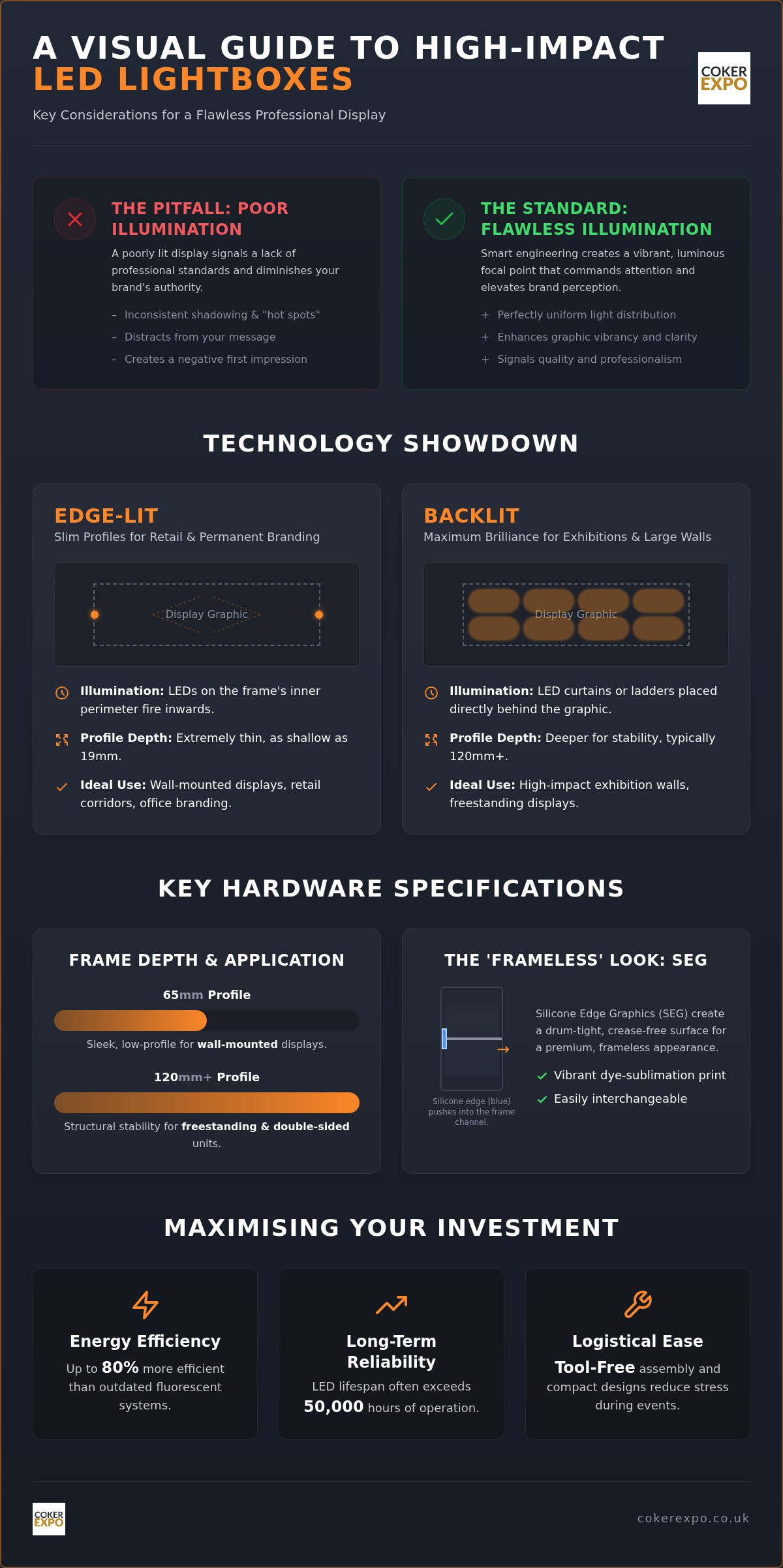
An integrated display functions as a precision-engineered infrastructure for your brand. It consists of a high-performance frame, a calibrated light source, and a tensioned graphic panel. While the historical definition of what is a lightbox encompasses everything from film viewing to tracing tables, in the commercial B2B sector, it represents a high-impact medium for advertising. The transition from fluorescent tubes to energy-efficient LED modules has redefined the industry. Fluorescent systems were heavy and prone to flickering. Modern led lightboxes provide up to 80% better energy efficiency and a lifespan often exceeding 50,000 hours, making them a sound long-term business investment.
Uniformity is the hallmark of quality. A professional display must provide consistent light distribution across the entire graphic surface. Any variation leads to shadowing or "hot spots" that distract the viewer and diminish your brand's authority. High-traffic environments like trade shows and retail showrooms demand this level of technical precision. When implemented correctly, led lightboxes transform brand perception by creating a vibrant, luminous focal point that commands attention without the visual noise of traditional unlit stands.
Edge-Lit Lightboxes: Slim Profiles for Retail and Events
Edge-lit systems mount high-output LEDs along the inner perimeter of the frame. These lights fire inwards, using a reflective backing or a light guide plate to disperse illumination across the graphic. This configuration allows for incredibly thin profiles, often as shallow as 19mm. They are the primary choice for wall-mounted displays in retail corridors or permanent office branding where space is limited. The LED Slimline Lightbox, available in sizes from A0 to A4, serves as a versatile entry-level option. It combines a sleek aesthetic with a snap-frame mechanism for rapid graphic changes, ensuring your messaging remains current with minimal effort.
Backlit Lightboxes: Maximum Depth and Brilliance
Backlit technology takes a different approach by placing LED curtains or ladders directly behind the graphic panel. This mechanism ensures intense, even brilliance across much larger surface areas. Because the light source isn't restricted by the distance it can travel from the frame edge, backlit systems effectively prevent the "dark spots" that can plague oversized displays. These units are the standard for high-impact exhibition walls. The HBBL Backlit Tension Fabric Display Lightbox is specifically designed for these scenarios. It provides the visual depth and punch required to stand out in a crowded hall, ensuring your graphics remain crisp and legible from a distance.
Key Specifications: Choosing the Right Frame and Graphic Type
Selecting the correct hardware for led lightboxes requires a balance between aesthetic goals and logistical constraints. Frame depth is a critical factor in this decision. Wall-mounted frames typically utilise a 65mm depth, providing a sleek, low-profile look that adheres to safety requirements in narrow corridors. For freestanding units, a depth of 120mm or more is standard. This additional width provides the structural stability needed for double-sided configurations and ensures there is enough space to house the internal modules required for high-performance LED technology.
Material choice also dictates the lifespan of your investment. Aluminium is the industry standard for permanent durability, offering a premium finish that resists warping over time. If your team travels nationally for trade shows, lightweight PVC segments may be the better choice for their ease of transport and rapid assembly. Whether you require a single-sided unit for a perimeter wall or a double-sided display to act as a room divider, the frame must be robust enough to maintain tension across the graphic panel.
Tension Fabric Systems (TFS) and SEG Graphics
Silicone Edge Graphics (SEG) have transformed brand presence by providing a "frameless" appearance. The fabric graphic features a thin silicone gasket sewn around the perimeter, which presses into a recessed groove in the frame. This creates a drum-tight, crease-free surface that looks professional from every angle. We utilise dye-sublimation printing for these systems. This process bonds ink directly into the fabric fibres, producing vibrant, light-fast colours that remain durable through multiple campaigns. For a deeper dive into these configurations, see The Ultimate Guide to Exhibition Lightboxes.
Acrylic and Snap-Lock Systems
In high-durability retail environments, traditional acrylic panels remain a reliable choice. These systems often feature snap-lock frames, allowing staff to update promotional posters in seconds without specialist tools. The LED Slimline Lightbox is a prime example of this utility, using a backlit print on a rigid substrate to maintain clarity and impact in showrooms. If you need a bespoke configuration for a specific retail fit-out, you can view our full range of display solutions to find the ideal match for your floor plan.
Standout LED Lightbox Solutions for 2026
Selecting the right hardware depends entirely on your specific environment. While wall-mounted frames provide permanent branding for retail showrooms, exhibition spaces require more versatile solutions. Freestanding led lightboxes act as architectural anchors within a trade show stand, providing both illumination and structural definition without the need for fixed walls. These units are designed to be modular, allowing you to create large-scale light walls or individual focal points based on your floor plan.
Freestanding and Portable Powerhouses
The HALO LED Edge-Lit Lightbox Display represents the professional standard for event environments. It combines a robust aluminium frame with high-output LEDs to deliver a crisp, vibrant finish. For teams prioritising rapid transport and stability, the Aura Edge-Lit LED Display Lightbox utilises a 120mm PVC profile. This deeper profile ensures the unit remains stable in high-footfall areas while remaining light enough for a single person to assemble. You can also extend your branding to functional furniture with the HALO LED Lightbox Display Counter. It serves as an illuminated focal point for reception areas, ensuring your first point of contact is as impactful as your main display.
Specialised and Dynamic Displays
Innovation in 2026 is driven by movement. The Animated LED backlit Dynamic lightbox uses programmed light sequences behind the graphic to simulate motion. This technology allows you to highlight specific product features or create flowing background patterns; it draws the eye more effectively than static images. For external environments, the Outdoor Slimline Lightbox LED provides a weather-resistant solution that maintains brand consistency outside the venue. If your stand design requires more organic shapes, the HALO Curved Edge-Lit LED Display Lightbox offers unique architecture that breaks away from traditional rectilinear frames.
If you are ready to upgrade your event presence with high-performance hardware, you can browse our full range of professional lightboxes to find a system that fits your 2026 strategy.
Logistics and Maintenance: Making Your Investment Last
Logistics often determine the ultimate ROI of a display. Bulky hardware that requires specialist tools increases labour costs and adds unnecessary stress to event build-outs. Modern led lightboxes solve these issues through tool-free assembly. Most systems utilise push-fit connectors or simple thumb-screws, allowing event staff to construct high-impact light walls in minutes. This speed of fulfillment is a core requirement for the fast-paced UK exhibition circuit where every minute of build time is critical.
Ease of Assembly and Transport
Modular systems like the GL120 are essential for national exhibitors who frequently move hardware between venues. These frames consist of compact segments that fit into padded carry bags, protecting the internal components from transit damage. Pre-installed LED modules provide immediate "plug and play" functionality. This eliminates the need for an electrician to handle complex wiring on-site. For more on integrating these units into a cohesive stand layout, read our Exhibition Stand Design: The Professional Guide.
Long-term Maintenance and Graphic Replacement
Maintaining the visual quality of your investment requires minimal effort but consistent care. Tension fabric graphics (SEG) should be folded with the print facing inwards to prevent surface scuffing. If the fabric becomes soiled, our dye-sublimation prints are typically machine washable on a cool cycle. The primary business advantage here is the ability to update your messaging without replacing the frame. New SEG prints allow for rapid campaign pivots at a fraction of the original hardware cost, ensuring your brand remains current across multiple shows.
Storage is another critical factor. You should always keep power drivers and cables in dedicated compartments to avoid crushing the LED modules or damaging the electrical leads. Ensure your hardware meets UKCA standards and that all fabrics carry the necessary fire-retardant certifications required by major UK venues. Efficient led lightboxes already exceed the 45 lumens per watt minimum standard, with many professional units approaching the 120 lumens per watt efficiency required by 2028. This ensures your energy costs remain manageable during multi-day events. You can browse the full range of led lightboxes to find the ideal system for your next campaign.
Future-Proof Your Brand Presence with High-Performance Displays
Selecting the right illuminated display for 2026 is a strategic decision that impacts both your brand authority and your operational efficiency. Professional led lightboxes provide the necessary infrastructure to stand out in high-pressure environments, provided you prioritise lighting uniformity and modular construction. By moving from bulky, static frames to agile systems with interchangeable graphics, you ensure your marketing remains adaptable across multiple campaigns without the need for constant hardware reinvestment.
Our commitment to UK-based manufacturing and expert support provides the reliability you need for national exhibitions. We utilise premium dye-sublimation printing to ensure your colours remain vibrant and light-fast, while our modular designs simplify the physical experience for your event staff. Whether you require a permanent retail fixture or a portable trade show wall, the right hardware represents a sound business investment that pays dividends in visibility and ease of use. We look forward to helping you achieve a significant impact on your next exhibition floor.
Ready to elevate your next display? Browse the Complete LED Lightbox Collection and secure a professional-grade solution for your 2026 events.
Frequently Asked Questions
How long do the LEDs in a professional lightbox typically last?
LEDs in professional-grade units typically last for 50,000 hours or more. This equates to over five years of continuous 24/7 operation, though for most exhibitors, this lifespan covers a decade of seasonal events. Unlike older fluorescent tubes, these modules maintain their brightness and colour temperature without flickering. This long-term durability makes led lightboxes a highly cost-effective infrastructure investment that eliminates the need for frequent bulb replacements.
Can I change the graphics in my LED lightbox myself?
Yes, our systems are designed for rapid, tool-free graphic updates by your own event staff. Tension fabric systems utilise a silicone edge gasket that simply presses into the recessed frame channel. Snap-lock frames for retail posters operate on a similar principle, allowing you to swap campaign visuals in seconds. This flexibility allows you to maintain a current message across multiple venues without the logistical cost of hiring specialist installation teams.
What is the difference between a single-sided and double-sided lightbox?
The primary difference lies in visibility and frame depth. Single-sided units are designed for perimeter walls and usually feature a slimmer 65mm profile. Double-sided lightboxes are deeper, often 120mm or more, to accommodate light modules that illuminate both faces. These are ideal for use as room dividers or central focal points in exhibition stands, as they capture visitor attention from two directions simultaneously without doubling your floor space requirement.
Do LED lightboxes get hot during long exhibition days?
Professional LED modules generate very little heat compared to traditional lighting. They convert energy into light more efficiently, meaning the frame and graphic remain cool to the touch even after twelve hours of continuous operation. This is a critical safety feature for busy exhibition halls where visitors may come into contact with your display. It also prevents heat-related warping or fading of the tension fabric and acrylic panels during long-term use.
Are tension fabric lightboxes better than acrylic ones for trade shows?
Tension fabric is generally superior for trade shows due to its portability and non-reflective surface. Fabric graphics can be folded, which significantly reduces transport volume and eliminates the risk of cracking inherent with large acrylic sheets. Fabric also doesn't suffer from the glare of overhead venue lighting. Acrylic remains a strong choice for permanent retail installations where a rigid, high-gloss finish is required for high-end showroom branding.
What power supply is required for a standard 1m x 2m LED lightbox?
A standard 1m x 2m unit requires a conventional UK 220-240V AC power supply. Most led lightboxes are "plug and play" systems that connect directly to a standard 13-amp 3-pin socket. Because LEDs are highly energy-efficient, a single power point can often support multiple units via a daisy-chain configuration. This simplicity reduces your on-site electrical costs and ensures your team can complete the setup without complex wiring requirements or specialist tools.
Leave a comment