

Formula 1 Exhibition Design: Lessons in High-Octane Brand Impact for 2026
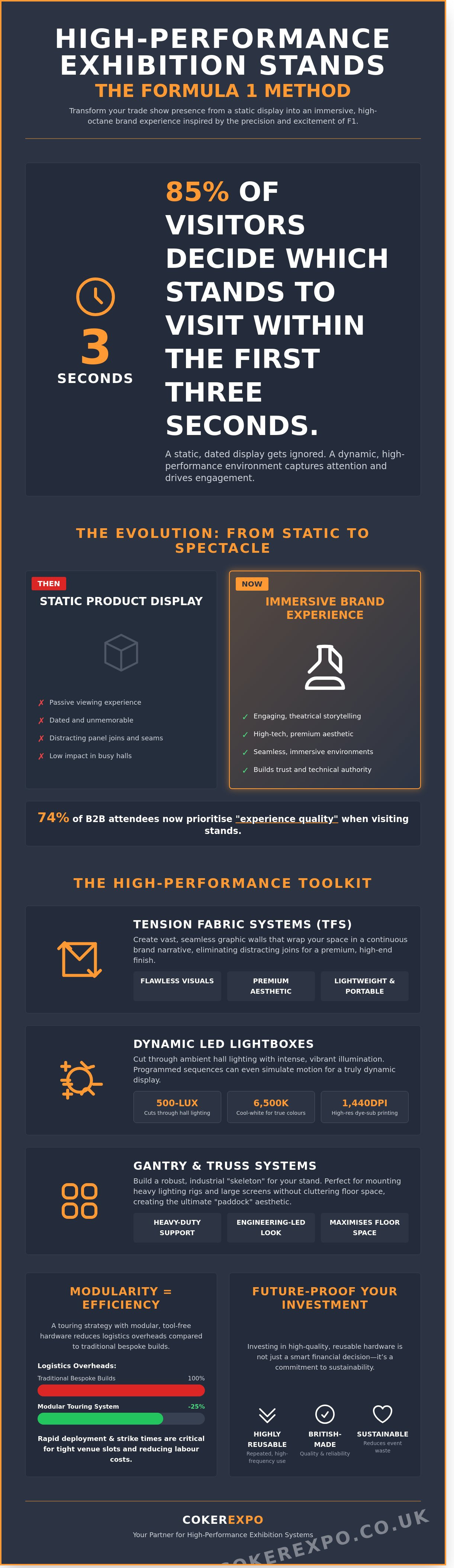
What if your trade show stand could generate the same visceral, 200mph excitement as a Grand Prix starting grid? You've likely felt the frustration of a static display that looks dated the moment it's assembled. With 85% of trade show visitors deciding which stands to visit within the first three seconds of sight, a "flat" presence simply won't cut it for your 2026 events. The 2023 formula 1 exhibition in Madrid welcomed over 350,000 visitors by ditching traditional boards for immersive, high-octane environments. It's proof that high-performance branding isn't just for the track.
We understand that you need to balance this high-tech aesthetic with the practical realities of transport and setup. You'll discover how to replicate this premium paddock look using our professional-grade hardware, from seamless tension fabric graphics to robust gantry systems. We'll show you how to use tool-free modular components and LED lightboxes to build a high-impact presence that remains entirely portable. This article breaks down the specific hardware and design strategies you need to transform a standard plot into a high-performance brand experience.
Key Takeaways
- Learn why the modern formula 1 exhibition has evolved into a theatrical brand experience and how this shift defines the current gold standard for experiential marketing.
- Discover how to use tension fabric lightboxes and seamless graphics to recreate the high-octane atmosphere and premium aesthetic of a professional racing environment.
- Understand how to utilise industrial gantry and truss systems to build a robust, engineering-led "skeleton" for your lighting rigs and heavy displays.
- Gain actionable insights on adapting elite paddock design principles for standard B2B shell schemes to maximise your brand impact regardless of stand size.
- Explore the long-term value of investing in high-quality, British-made modular hardware that supports your sustainability goals through repeated, high-frequency use.
The Evolution of the Formula 1 Exhibition: Beyond the Racing Car
The days of a static car on a plinth are over. A modern formula 1 exhibition is a theatrical brand experience that prioritises narrative over simple display. Since the sport's commercial evolution accelerated in 2017, Formula One has set the gold standard for experiential marketing by blending technical heritage with immersive storytelling. It's no longer enough to show a product; you have to create an environment. By 2026, UK trade show visitors will demand this level of engagement. The "Experience Economy" has shifted expectations. Recent industry reports indicate that 74% of B2B attendees now prioritise "experience quality" when choosing which stands to visit. They want to be part of the story, not just spectators.
F1 has moved from car-centric displays to holistic environments. These spaces use scale, sound, and light to trigger an emotional response. For an exhibitor, this means moving away from traditional shell schemes toward bespoke, immersive structures. The goal is to make the visitor feel the heat of the track and the pressure of the pit lane. This approach transforms a passive walkthrough into an active memory, ensuring your brand stays with the lead long after the event ends.
What Makes an F1 Display Impactful?
Static displays need to feel alive. We achieve this through dynamic lighting and large-scale tension fabric graphics that suggest velocity. Use clean, industrial lines to communicate precision. The 'paddock' aesthetic is particularly effective for B2B audiences. It projects a sense of technical authority and readiness. When your stand looks like a high-performance garage, it reinforces your brand's reliability. It tells the visitor that your internal processes are as sharp as your presentation. This isn't just about aesthetics; it's about building trust through a professional, high-spec environment. High-performance gantry systems provide the necessary infrastructure to support heavy tech and lighting rigs without cluttering the floor space.
The Rise of the Touring Exhibition
The 2023 Madrid exhibition proved that scale doesn't have to sacrifice mobility. Moving high-value assets across international borders requires a modular mindset. The secret lies in robust, lightweight aluminium frames and tool-free assembly systems. These components allow for rapid deployment and strike times. This is critical when venue slots are tight and labour costs are high. For UK businesses, adopting a touring strategy for national roadshows can reduce logistics overheads by 25% compared to traditional bespoke builds. It's about creating a repeatable, high-impact presence that's easy to transport and quick to build. This modularity ensures your brand remains consistent, whether you're in London, Birmingham, or Manchester.
Engineering Immersion: Lightboxes and Tension Fabric in F1
High-performance exhibition design mirrors the precision of the paddock. Creating a successful formula 1 exhibition requires hardware that can withstand 12-hour daily operation while maintaining visual intensity. Large-scale lightboxes are the primary tool for this. They simulate the high-contrast glow of a night race, effectively cutting through the 500-lux ambient light common in modern UK exhibition halls like the NEC or ExCeL London. Real Studios' design of the F1 Exhibition demonstrates how seamless graphics create a premium, high-octane environment. By using Tension Fabric Systems (TFS), designers wrap entire rooms in a continuous brand narrative. This eliminates the distracting vertical joins found in traditional panel systems, ensuring the visitor's focus remains entirely on the engineering story.
Dynamic Lightboxes and Animated Graphics
Programmed LED sequences behind the fabric bring static images to life. A 60-frame-per-second lighting loop can simulate the blur of a car passing at 200mph. It's a technical solution that guides the visitor's eye through a specific narrative path without the cost of a full-scale video wall. To achieve iconic racing liveries, we use dye-sublimation printing at 1,440dpi. This ensures the specific brand colours remain accurate under intense 6,500K cool-white illumination. The result is a vibrant, punchy display that stays true to the team's identity.
The Versatility of Tension Fabric Frames
Fabric frames allow for massive, uninterrupted spans up to 50 metres wide. These systems are robust yet lightweight, making them ideal for a formula 1 exhibition or any high-pressure UK install where rig times are tight. Dye-sublimation ensures deep saturation, which is vital for the high-octane aesthetic. You can integrate 4K screens directly into the fabric walls using internal support brackets, creating a hybrid digital-physical space. If you're planning a high-impact stand, exploring modular fabric displays provides the necessary infrastructure for these complex, bespoke builds.
- Seamless Spans: Achieve visuals up to 3 metres high by 50 metres wide without a single join.
- Backlit Impact: 120mm deep profiles provide even light distribution across the entire graphic surface.
- Tool-Free Options: Many of our tension systems feature simple connector technology for faster onsite assembly.
- Interchangeable Graphics: Update your brand narrative for the 2026 season by simply swapping the fabric skin.
Structural Sophistication: Using Truss for High-Impact Displays
Formula 1 is the ultimate marriage of raw power and clinical precision. Your stand structure should reflect this. Industrial gantry and truss systems aren't just supports; they're the literal skeleton of the display. They mirror the engineering-led nature of the paddock and the factory floor. In a high-pressure environment, you need a system that handles heavy lifting without breaking a sweat. High-spec lighting rigs and suspended car components require the robust load-bearing capacity of 290mm or 400mm aluminium quad truss. This hardware provides the necessary frame for total technical immersion.
The official Formula 1 Exhibition showcases how structural elements define spaces like the 'Pit Wall' and 'Design Lab' to create an authentic atmosphere. You can balance this 'raw' engineering aesthetic with sleek, high-definition branding panels. It's a contrast that works. The exposed metal communicates technical expertise while the tension fabric graphics deliver the brand message. Safety is paramount in UK venues like the NEC Birmingham or ExCeL London. All overhead rigging must meet strict PLASA standards and undergo rigorous stress testing. We ensure every bolt and coupler exceeds the 5:1 safety factor required for public spaces, giving you total peace of mind during the event.
Exhibition Truss as a Design Statement
Exposed trussing does more than hold lights; it communicates strength. It tells the visitor you understand the mechanics of the sport. You don't have to settle for standard silver. Customising truss with powder-coated finishes in specific brand colours creates a cohesive look. Use these structures to create distinct zones. A 6-metre high gantry can define a 'Technical Zone' without the need for restrictive walls, maintaining an open-plan feel that encourages footfall across the stand.
Modular Gantry vs. Bespoke Builds
Speed is everything in the exhibition world. Modular gantry systems offer a massive advantage over bespoke timber builds because they're cost-efficient and reusable. Investing in a modular system can reduce build costs by 30% over three show cycles. These systems allow for rapid, often tool-free assembly, which is vital when you've only got a tight 24-hour window for a build-up. A standard 290mm quad truss can support a distributed load of over 900kg on a 4-metre span. This capacity is essential for hanging heavy 4K LED screens or engine replicas that a traditional shell scheme couldn't dream of supporting. We focus on providing the infrastructure that makes your formula 1 exhibition presence both safe and spectacular.
Replicating the Paddock: A Practical Guide for B2B Exhibitors
You don't need a multi-million pound budget to capture the technical precision of a formula 1 exhibition. Most UK exhibitors operate within 3x3 or 6x3 metre shell schemes, yet these compact spaces can still project a high-octane brand image. The secret lies in applying the "paddock" philosophy: every millimetre must serve a functional or aesthetic purpose. By working with experienced exhibition stand designers, you can map out a high-performance layout that prioritises clean lines and logical zones.
Lighting is the most overlooked element in standard UK trade shows. Move away from the basic yellow-toned spots provided by venues. Instead, invest in integrated LED systems that offer a crisp, daylight-balanced 5600K colour temperature. This mimics the clinical, high-tech environment of an F1 garage. Complete the look with sleek, matte-black or brushed aluminium promotional counters. These provide a robust platform for technical demonstrations while hiding the "clutter" of brochures and lead scanners.
Maximising ROI with Modular Stands
Modular hardware provides the infrastructure for a professional presence without the logistical headache of custom builds. A premium pop up stand can be elevated by using high-resolution tension fabric graphics that eliminate visible seams. For brands sharing complex engineering data, using A0 size graphics allows for technical storytelling that remains legible from a distance. In the fast-paced 2024 event circuit, tool-free assembly has become the industry standard. It enables a small team to build a 6-metre stand in under 45 minutes, significantly reducing labour costs and setup stress.
Creating Interactive 'Pit Stops'
Turn your floor space into an interactive "pit stop" to drive engagement. Industry data from early 2024 indicates that interactive displays increase visitor dwell time by 35% compared to static stands. Integrate tablets directly into your modular counters to allow for self-guided digital tours. If you're showcasing physical hardware, use motorised display turntables to provide 360-degree visibility of your product's craftsmanship. Design your visitor flow to mimic a technical paddock journey, guiding prospects from a high-impact visual "hook" at the front to a quiet, seated consultation area at the rear.
Ready to upgrade your event presence? Explore our range of modular exhibition systems to build your high-performance stand today.
Future-Proofing Your Stand with CokerExpo
The 2026 season demands a shift in how businesses approach their physical presence. You aren't just building a stand; you're engineering a brand destination that mirrors the technical precision of a formula 1 exhibition. CokerExpo provides the British-made hardware required for this transition. Our modular systems focus on a "buy once, use many" philosophy. This approach reduces waste by up to 40% compared to traditional bespoke timber builds that often end up in a skip after three days. Investing in high-grade aluminium frames ensures your kit survives the rigours of 15 or 20 shows a year without losing structural integrity.
Transitioning to a brand destination means thinking about the user experience of the attendee. It’s about creating an environment that feels permanent and premium, even if it was assembled in an hour. By using professional-grade components, you ensure that every touchpoint reflects the high-performance nature of your business. We support national exhibitors by providing the logistical backbone for these events, from initial CAD planning to the final hardware check.
Fast Turnaround and UK Reliability
Local production at our Hampshire-based facility means we control every stage of the timeline. We frequently deliver 48-hour turnarounds on replacement graphics when event deadlines shift or last-minute branding changes occur. Every fabric we print and every frame we supply meets strict UK fire safety regulations, specifically BS 5867 Part 2. This isn't just about compliance; it's about removing the stress of venue inspections. Our technical team provides bespoke modular configurations, allowing you to adapt a 3x3m footprint into a 6x3m space using the same core components. Tool-free assembly remains our signature, letting your staff set up a professional display in under 45 minutes.
Investing in High-Performance Infrastructure
Professional-grade lightboxes and gantry trussing represent a long-term business asset rather than a one-off marketing expense. A high-output LED lightbox system offers a lifespan exceeding 50,000 hours, ensuring your brand remains bright across years of trade shows. These systems are designed to scale. You can start with a single backlit wall and expand into a multi-level structure as your budget grows. For your next formula 1 exhibition or high-impact trade event, follow this final planning checklist:
- Verify stand height limits 6 months in advance to maximise overhead visibility.
- Audit your modular inventory 30 days before the event to identify any required additions.
- Ensure all textile graphics are printed using dye-sublimation for scratch-resistant durability.
- Confirm your logistics partner understands the "last mile" delivery constraints of major UK venues like the NEC or ExCeL London.
- Test your LED lighting circuits 14 days prior to dispatch to ensure 100% reliability on opening morning.
By focusing on robust, reusable infrastructure, you secure a higher return on investment while meeting the increasing demand for sustainable exhibiting. CokerExpo stands ready to help you navigate these technical requirements for 2026 and beyond.
Drive Your Brand Performance into 2026
Success at a formula 1 exhibition or high-profile trade show requires more than just floor space; it demands engineering precision. You've seen how integrating structural truss systems and vibrant tension fabric lightboxes creates the immersive paddock atmosphere that captures B2B leads. By 2026, the standard for engagement will be higher, making tool-free modularity and fast-turnaround hardware essential for staying ahead of the competition.
CokerExpo provides the infrastructure for your success with over 25 years of UK exhibition expertise. We are specialists in tool-free modular systems that simplify complex builds, backed by comprehensive event management and planning services. Whether you need a robust gantry or a seamless fabric display, our British-made solutions are built for durability and impact. It's time to elevate your display strategy with hardware that performs under pressure.
Explore our range of high-performance exhibition displays at CokerExpo
We look forward to helping you cross the finish line first at your next event.
Frequently Asked Questions
What is a Formula 1 exhibition and what can I see there?
A Formula 1 exhibition is a curated, immersive journey through the sport's history, engineering, and future. You'll typically see 6 or 7 themed galleries featuring iconic chassis like the 1988 McLaren MP4/4, interactive race simulators, and technical displays of power units. These events use high-end AV technology and rare artefacts to explain the precision engineering behind the world's fastest racing series.
How do they display real F1 cars in temporary exhibitions?
Engineers use reinforced steel platforms and specialised wheel chocks to secure 798kg vehicles safely within a temporary environment. For multi-level displays, 2-tonne capacity scissor lifts or custom gantry cranes position the chassis on raised plinths. Most displays occupy a 6-metre diameter footprint to allow 360-degree public viewing while maintaining strict health and safety distances.
Can I use F1-style lighting for my own trade show stand?
You can replicate this high-octane look by using 4000K to 5000K cool-white LED spotlights mounted on an aluminium overhead gantry. This specific colour temperature mimics the clinical, high-tech atmosphere of a professional race garage. We recommend a minimum brightness of 500 lux on your focal products to ensure your brand stands out against the ambient hall lighting.
What is the best way to create large-scale graphics for an exhibition?
Tension fabric displays using dye-sublimation printing are the industry standard for creating seamless, high-impact visuals. These systems allow for continuous graphics up to 50 metres wide without a single visible join or seam. The 210gsm polyester fabric stretches tightly over an aluminium frame, which creates a perfectly flat, non-reflective surface that looks professional under bright event lights.
Is exhibition trussing safe for indoor use at UK trade shows?
Aluminium trussing is completely safe for indoor use when it complies with BS EN 1999-1-1 Eurocode 9 structural design standards. Most UK venues require a 5:1 safety factor for all overhead equipment to ensure visitor security. Our 290mm box trussing supports spans of up to 12 metres, providing a robust framework for heavy lighting rigs and digital screens.
How much does it cost to replicate a high-end F1 aesthetic for a stand?
A 6m x 3m exhibition stand featuring high-gloss flooring, an LED gantry, and premium fabric graphics typically starts from £4,500. For a more expansive 50-square-metre space with interactive elements and bespoke counters, budgets usually range between £15,000 and £35,000. These figures cover all hardware and high-resolution printing but don't include the venue's floor space rental fees.
What are the benefits of using modular display systems over bespoke builds?
Modular systems provide 40% more versatility because you can reconfigure the same components for different stand sizes at future events. Unlike traditional timber builds, these aluminium frames are 100% recyclable and reduce on-site installation time by 5 hours on average. This makes them a smarter, more sustainable investment for a multi-date formula 1 exhibition tour or a busy trade show calendar.
Do I need tools to assemble a professional tension fabric display?
No, our professional-grade systems feature tool-free assembly using simple push-fit connectors and hand-tightened thumb-screws. A standard 3-metre back wall takes 2 people approximately 15 minutes to build from start to finish. This speed eliminates the need for expensive on-site contractors and ensures a stress-free setup, even if you've a tight deadline before the formula 1 exhibition doors open.
Leave a comment